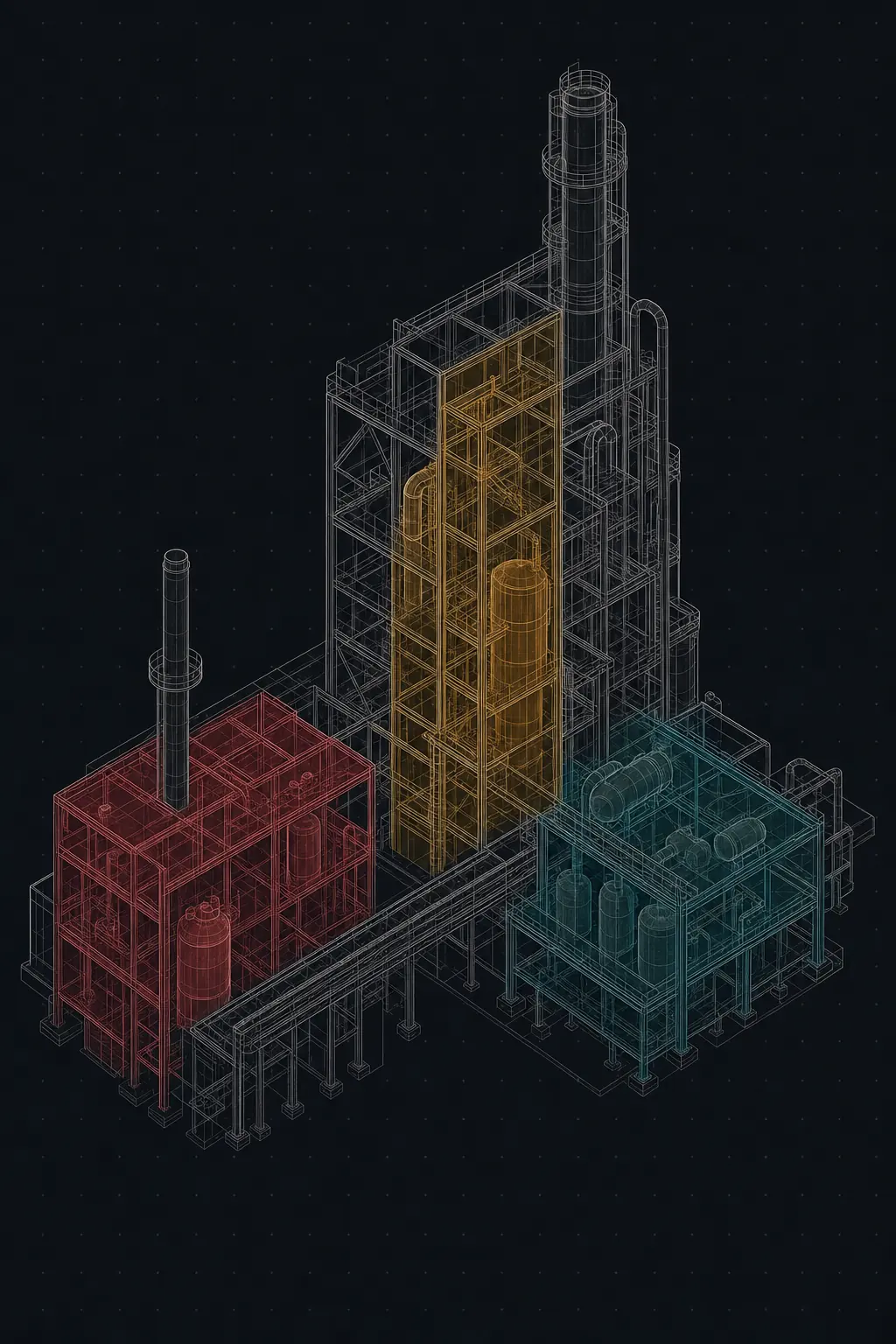
VissRad is an integrated suite of project controls, commissioning, work packaging and finance applications for industrial capital projects — where progress, cost, certification and payment stay tied to one another instead of drifting apart in eleven spreadsheets.
15 modulesPrimavera P6 importEarned value & EAC forecastingPower BI star-schema exportsSQLite or PostgreSQLDesktop, on-prem or cloud
Narrated overview
Nine minutes on what the suite does.
A narrated walk through the fifteen applications, the chain from field quantity to certified payment, and how the exchange layer keeps the numbers agreeing. Recorded, so you can watch it before deciding whether a live walkthrough is worth your time.
Eight minutes fifty, 1080p, with narration. The screens in it are the browser demo running on the demonstration dataset.
The problem
Projects don't fail on arithmetic. They fail on disconnection.
Every discipline keeps its own version of the truth. The schedule says one thing, the field says another, the cost report is a month behind, and the invoice gets approved because nobody could contradict it in time.
Progress is claimed, not verified
Subcontractor claims arrive as a percentage on a cover sheet. Without rule-of-credit steps and shift-level quantities behind them, there is no defensible number to argue with.
Cost lives outside the system
Commitments sit in procurement, actuals sit in finance, and the forecast sits in a workbook on one engineer's laptop. Reconciling them is a monthly archaeology exercise.
Turnover is a separate universe
Systemisation, ITRs, punch and certificates are managed apart from construction progress — so completion status never informs retention, billing or the forecast.
The chain
Every number holds a receipt from the one before it.
Progress is not a percentage somebody typed. It is a quantity, weighted by rule of credit, signed onto a certificate, and only then allowed to move money. VissRad keeps that custody chain intact across four applications.
Field quantity
A shift entry records what was actually installed — spools, welds, terminations — against the subsystem that owns the scope.
Evidence · shift record
Weighted progress
Rule-of-credit steps convert the quantity into earned progress. The earned-value picture updates on entry, not at month end.
Evidence · rule of credit
Certificate
MCC, RFCC and RFSU gates refuse to advance while check sheets or category A punch items remain open against the subsystem.
Evidence · signed gate
Payment
A claim is checked against certified field quantities before approval. Retention releases on the certificate, and the cost report already knows.
Withheld unless verified
The rule: a link cannot be claimed without the one behind it — which is why an overclaim surfaces in the approval queue rather than in a reconciliation three months later.
What integration buys you
An eight-point overclaim, caught before the cheque.
A subcontractor submits a progress claim at 62% complete. In VissRadPCS the same scope is carrying 54% of field-certified progress, built from weighted rule-of-credit steps and shift-by-shift quantity entries.
Because VissRadARAP verifies claims against PCS field data through the Link exchange layer, the eight-point gap surfaces in the approval queue instead of after payment — with the certified evidence attached.
Scenario from the VissRad Suite demonstration dataset.
A certificate is not paperwork. It is the moment money is allowed to move.
VissRad design principle
The suite
Fifteen applications. One record of the project.
Each application is installed, licensed and run on its own — a cost engineer never has to open the payables system to do their job. They exchange business documents through Link, so the numbers agree.
VissRadPortfolio
Portfolio health
The overview above every other module: stage-gate pipeline health, the cost and forecast position, schedule and earned value, and the risk and readiness exceptions that need a decision this week — across FEED, preconstruction, detailed engineering, execution and commissioning.
Stage gates5 phasesExceptions
VissRadFEED
FEED tracking
Front-end engineering design through the sanction gates: G0 to G3 gate readiness scoring, FEED deliverables against a 21-milestone skeleton, an optioneering study register, estimate basis by AACE class, a three-method duration benchmark and the pre-FID risk register.
G0–G3 readinessAACE classOptioneering
VissRadPreCon
Preconstruction
Making a sanctioned project buildable: constructability reviews, contracting strategy and bid packages, long-lead procurement with float to need-by, craft labour and logistics, permits, and a mobilisation readiness case.
Bid packagesLong-lead floatMobilisation
VissRadDEng
Detailed engineering
Engineering to IFC: a deliverable register by revision and issue code from IFR through IFA, IFD and IFC to AB, man-hour progress by rule of credit, review and transmittal cycles, MTO quantity growth, changes and TQs, and EWP handover to the field.
Issue codesRule of creditEWP handover
VissRadPCS
Project controls
Completions, field progress, earned value, cost control and forecasting for one project per file. Rule-of-credit progress, shift entry, PF and CPI, five EAC methods and a contingency drawdown register.
Earned valueP6 importCost report
VissRadSU&C
Startup & commissioning
System, subsystem and tag hierarchy with ITR check sheets, punch lists and test packages, driving a gated certificate ladder from RVC through MCC, RFC, SCC and DCC to HOC.
ITRs & punch6 gatesNavisworks
VissRadCost
Cost management
A cost breakdown structure with budget control, commitments, an actuals ledger, change management, forecasting, earned value, cash flow and reports — nine views over one cost engine.
CBSChange controlCash flow
VissRadAWP
Advanced work packaging
The full CWA → CWP → EWP → IWP hierarchy with a constraint matrix, readiness scoring, an IWP release gate, path of construction, look-ahead and field progress.
IWP gateConstraintsLookahead
VissRadERP
Finance core — FI + CO
General ledger, accounts payable and receivable, cost centre accounting and internal orders, driven by a keyboard-first transaction-code command bar with period control, carry-forward and reconciliation.
GL / AP / ARControllingPeriod close
VissRadARAP
Payables & receivables
Invoice intake and coding, three-way PO/receipt/invoice matching, progress-claim verification against field data, a role-based approval queue, retention withheld and released on certificate, and payment runs.
Three-way matchRetentionAging
VissRadEST
Estimating
Discipline takeoff and cost estimating for piping, equipment, engineering and construction scope. Three methods sit side by side per discipline — parametric, known quantity and detailed takeoff — and only the selected one feeds the rollup to total installed cost.
3 methodsAACE classBenchmark check
VissRadSCH
Schedule analysis
Schedule development and analysis over XER, XML, CSV and XLSX sources, feeding activity structure and dates into progress, packaging and 4D sequencing. S-curve, earned value, critical path, float distribution and schedule quality in one place.
P6 importEarned valueFloat
VissRad4D
Visual sequencing
Pairs one P6, CSV or XLSX schedule with one elevation drawing and paints construction status over time. Planned sequence, progress versus plan and forecast views with SPI, finish variance and an S-curve. No 3D model required.
No model neededSPIS-curve
VissRadBI
Reporting & exports
Star-schema exports and report packs designed for Power BI modelling, plus read-only ODBC connectivity for ad-hoc analysis. Man-hour loading, earned value and the controls pack read the same facts the applications wrote.
Star schemaPower BIODBC
VissRad Computer
Research desk
A research and analysis desk that works online with citations, or offline over an index of your own PDFs, workbooks, schedules and XER files. Runs Python over project data, with one toggle between the two modes.
Online or offlineCited answersPython
The exchange layer
VissRad Link
Document exchange
Not a sixteenth application — the outbox and inbox layer that carries eleven business document types between the fifteen, with idempotent resends, a retry ladder and full replay from the hub console.
VissRad is not one monolith with one database. Each application owns its own data and sends signed business documents to the others through Link — the same way real organizations already work, only without the re-keying.
VissRadPCS
Issues a completion certificate
progress_certificate
VissRadARAP
Releases the withheld retention
VissRadARAP
Codes and approves a vendor invoice
vendor_invoice
VissRadERP
Posts it as an AP document
VissRadERP
Records commitments and actual costs
commitment · actual_cost
VissRadPCS
Refreshes the cost report and forecast
11
Business document types on the exchange
3
Transports — folder, HTTP hub, same-machine direct
7
Retry attempts on a backoff ladder before escalation
0
Duplicate postings — idempotency keys make resends safe
VissRad4D
Schedule time, painted onto a picture of the job.
Most 4D tools demand a federated model, a modeling team and a license stack before anyone can see the sequence. VissRad4D asks for one schedule and one elevation drawing.
Draw the regions once, map them to activities, and the drawing colors itself by status over time — planned sequence, progress versus plan, and forecast, with SPI, finish variance, an S-curve and an activity register alongside.
Takes P6 XER or XML, CSV or XLSX
Backdrop elevation drawing, Navisworks viewpoint, or optional live 3D
Standalone by design — its own database, no suite install required
Regions colored by construction status — status over time on a single elevation
Runs on your machine or on your own server — your API key, your files
VissRad Computer
Ask questions of your own project record.
A working assistant rather than a chat window. Point it at a folder of specifications, estimating workbooks, schedules and vendor documents, and it builds a local full-text index that answers with the source chunk cited back to the file.
Switch to online mode for web research with citations, or stay fully offline where network tools are hidden and blocked. It runs Python over your data for the estimating and schedule work that a chat interface cannot do.
Indexes PDF, XLSX, DOCX, CSV, XML and XER
Connects to any OpenAI-compatible endpoint with your own key
Deploys as a Windows application or a private hosted server
Deployment
One laptop, one plant network, or your cloud.
The same applications run in all three shapes. Nothing about the architecture forces you into a hosted subscription to get started.
Single machine
Standalone
SQLite databases per application, with Link running over a watched folder or a same-machine direct exchange. Suitable for one estimator or one controls engineer.
On premises
Plant network
PostgreSQL behind the Link hub, with an authenticated REST transport across the site network. Data never leaves your environment.
Cloud
Hosted
Managed PostgreSQL with a replicated Link hub behind TLS, for joint ventures and multi-office teams working the same capital project.
What VissRad does not claim
Primavera P6 is a file-based import, not a live two-way integration. Payment files are generated in NACHA and ISO 20022 formats but are not bank-certified for transmission. Live 3D model translation depends on your own Autodesk platform entitlements. We would rather tell you this on the website than in month three.
Built by practitioners
VissRad comes out of the estimating workbook, not a product roadmap.
VissRad is built by Pennington Group Associates, a Houston practice delivering data driven project management and controls. Every screen exists because a live capital project needed it — industrial takeoff, P6 schedule data, earned-value reporting, procurement and payables. We still take that work on directly.